LAZURE: its origin and development.
St. Augustine, FL
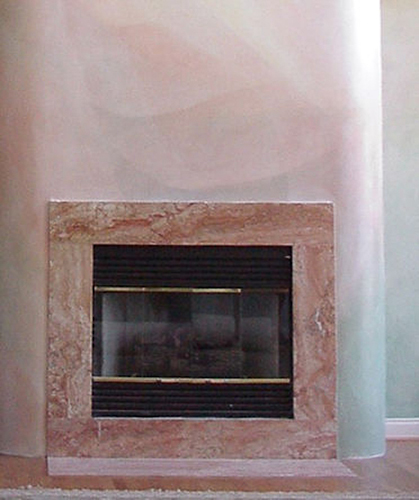
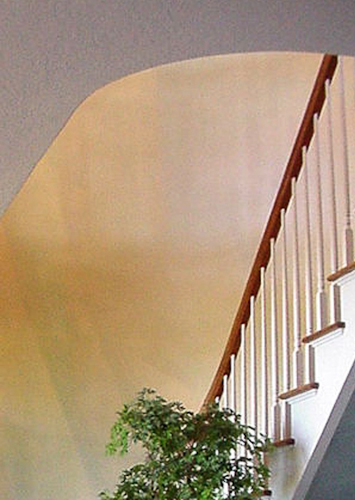
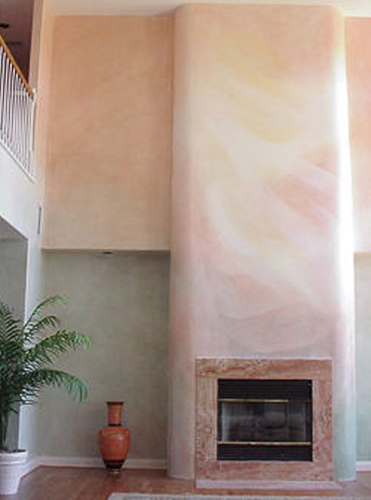
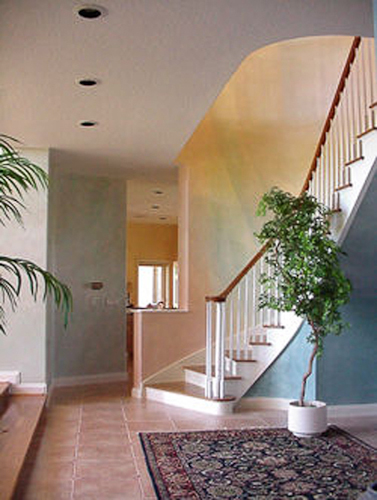
Lazure is layers of paint prepared nearly as thin and transparent as watercolor, consisting of water, binder, and pigment. It is applied with a rhythmical movement using large brushes. The final color is achieved using varied colors applied in several layers, over a white surface. Light passes through these thin layers of color and is reflected back, giving a pure color experience.
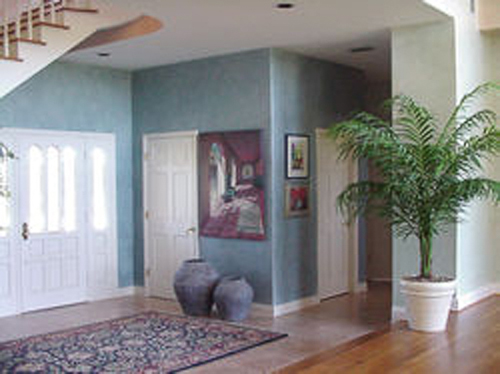
Flat, monotone colors are tiring on the eyes while color with variation of hue and tone stimulate and balance the activity of the eyes. The lazure method offers a creative and conscientious use of color that provides nourishment for the eye and the soul. It can achieve aesthetically beautiful results and act as a powerful healing influence amid the stress and tension of modern life. Lazure painted walls have enlivened many schools, as well as offices, restaurants, residences, curative and medical establishments and places of worship.
St. Augustine, FL
RUDOLF STEINER
Rudolf Steiner encouraged artists to paint walls with transparent radiant color. He used the word “lasur” to describe this new way of coloring walls—where color would feel as though it were in the space and not just on the wall. This provided a pure experience of color—as though one could “spiritually pass through the walls.” In 1907 and 1908 Steiner spoke of new impulses in the arts and demonstrated these new directions. In a lecture given in 1911 he spoke especially of the importance of transparent color on walls. The early attempts were often unsuccessful because the application of fluid color on vertical surfaces had not previously been achieved. Rudolf Steiner developed organic paints to be used on the two interlocking domes of the first Goetheanum building: first the white coats, then the medium to carry the pigments. Plant colors were also developed and used for the murals on these domes. Although Steiner’s original formulas lay dormant many years, research continued to re-establish organic mediums and plant color production. These were available in the 1970’s and further developed in the 80’s and 90’s and used in the completion of the second Goetheanum.
St. Augustine, FL
THE PIONEERS & EARLY EXAMPLES OF THE WORK
The question of using lasur in the Stuttgart School came up in 1953. Dr. Schwebsch saw the future potential of this impulse and convinced the faculty to use the lasur method in the reconstructed main building of the school. Manfred Ziegler and Julius Hebing were responsible for the work. By 1954 a few rooms in the Weleda building in Schwabish Gmud had also been painted. The first Waldorf School to be completely lasur painted was the Kristoffer School in Sweden, painted by Arne Klingborg and Fritz Fuchs in 1956-57. They used acrylic medium for the lasur work. During World War II, when linseed oil became scarce, developments were made by the inventors of artificial resins. These were used for general wall paint as well as for preparing acrylic medium that could be used for the lasur technique. This provided the boost needed for the lasur development. Still, the preferred materials would be organic, or natural, and not synthetic. It is well worth noting that the curative home “Mikaelgarden” (Jarna, Sweden) is one of the earliest examples of lasur. It was painted by Arne Klinborg and Helmut Lauer in 1935 using tempura paint. It is also an early example of the complete integration of glass, form, and color. The Swedish artist Arne Klingborg, and the English architect Rex Raab living in Germany, were very strong pioneers of the lasur work. Klingborg inspired Fritz Fuchs who subsequently became the best known lasur artist in Europe. In Jarna, Sweden many projects have been accomplished by Fritz Fuchs. His work can be seen in the Vidarklinneken, an anthroposophical hospital; several Waldorf Schools; many residential settings; and the Kulturhaus, a very large and beautiful building serving the larger community of southern Sweden. Naturally, many others have followed in their respective countries and huge projects have been accomplished. Uwe Janke, of Germany met with Fritz and Arne in 1961 about lasur work. Seven years later he patented the first professional grade large production paint products for lasur. Later Fritz got production rights to provide these paints in Sweden. The Farbygge Company became established in Jarna, Sweden. Perhaps the largest project to date was the Herdecke Community Hospital in Germany. The lasur work for this facility, with approximately 650 rooms, was planned and executed by Uwe Janke while Walter RoggenKamp painted the facade. Another large project was the Swiss curative community of Ekkarthof with nearly 300 rooms.
St. Augustine, FL
ROBERT LOGSDON’S INTRODUCTION TO LASUR
While a student at Emerson College in England (1973-74) Robert participated in painting several classrooms of the Michael Hall Waldorf School in Forest Row, Sussex. In the summer of 1973, through arrangements by Anne Stockton, painting teacher at Emerson, he was able to work with Fritz Fuchs on the Ekkarthof project in Switzerland, designed by Rex Raab. In 1974 he joined Anne Stockton on a tour of conferences in the U.S. introducing lasur and painting classrooms. After another year at Emerson and more lasur work in England, Robert returned to the U.S. in 1976 and founded ColorSpace to facilitate the work. Since then, others have taken up the work and now several professionals work in the U.S.
A NEW WORD FOR THE PROCESS
St. Augustine, FL
Robert Logsdon was using the German word but found that Americans confused lasur with laser – a newly emerging scientific technology utilizing light. The word lasur, he realized, was really a general term, like glaze in English. (What has become commonly known as “glaze finishes” evolved from the original beginnings known as lasur.) “Lasur,” therefore, did not articulate the specific method of painting to which we were referring. There was no specific word to describe what we were doing. After some research he formulated the word “lazure.” It is derived from azure—the only word in English he could find bearing some semblance of sound and meaning to the word lasur. The word is of Persian origin “lazuward” referring to lapis lazuli. It was passed on to the Arabs and then to the Spanish as “azur” or “azul.” Old French borrowed azur from Old Spanish and passed it on to English. At one time the French used “l’azure.” Our new American word, then, is most closely related to the French. The word azure, already in the English language, comes directly from the French and refers to the blue appearing in a clear sky. This fact convinced Robert to use the word lazure. Robert shared this with Rex Raab, a prominent architect in Germany, a poet, and a lazure enthusiast who has specified lazure for his projects, some with over 300 rooms. He supported the use of this new word and it is now recognized and used internationally.
 ColorSpace